
#022. Aboki
What goes on in the minds of babies?

Here's what I have for you:
•Ẹ kú ewu ọmọ
•What goes on in the minds of babies?
1. Ẹ kú ewu ọmọ
When a woman is relieved of the burden of pregnancy and she delivers the baby, the Yorùbá, in their reputation for perfect address, wishes the woman, and almost always the husband and relatives, Ẹ kú ewu ọmọ.
This literally means “Well done on surviving the dangers of childbirth.” Unlike the common “Congratulations on the safe delivery”, this Yorùbá greeting or wish is a mix of sympathy, relief, and congratulations. It acknowledges both the risk endured and the joy of new life.
Who survived the danger? The mother of course.
The changes in her body. The pain. The cramps. The labour pain. The tremor that burns and aches through that baby's pathway to life. The sharp knifes and the crazy medications to be administered. All these alone justifies the 'mother' singsong of the world.
But the Yorùbá recognizes that fathers went through burdens through the pregnancy period. It is a mental and physical tussle observing the changes in your wife, from light to heaviness. The stress of caretaking, of sometimes frequenting the hospital, of sleeplessness, of not just the unexpected financial demands day in day out, but also the emotional punches.
Yorùbá knows that the father also watches the infant head when sleeping on the cradle bed. That fathers get emotionally attached to their children and worry about them. That fathers, who know that having something is to risk losing it, also bear the fear of the child dying. That upon the birthing of the child, the father is also delivered of his own heartful pregnancy. So, they wish fathers too 'ẹ ku ewu ọmọ.'
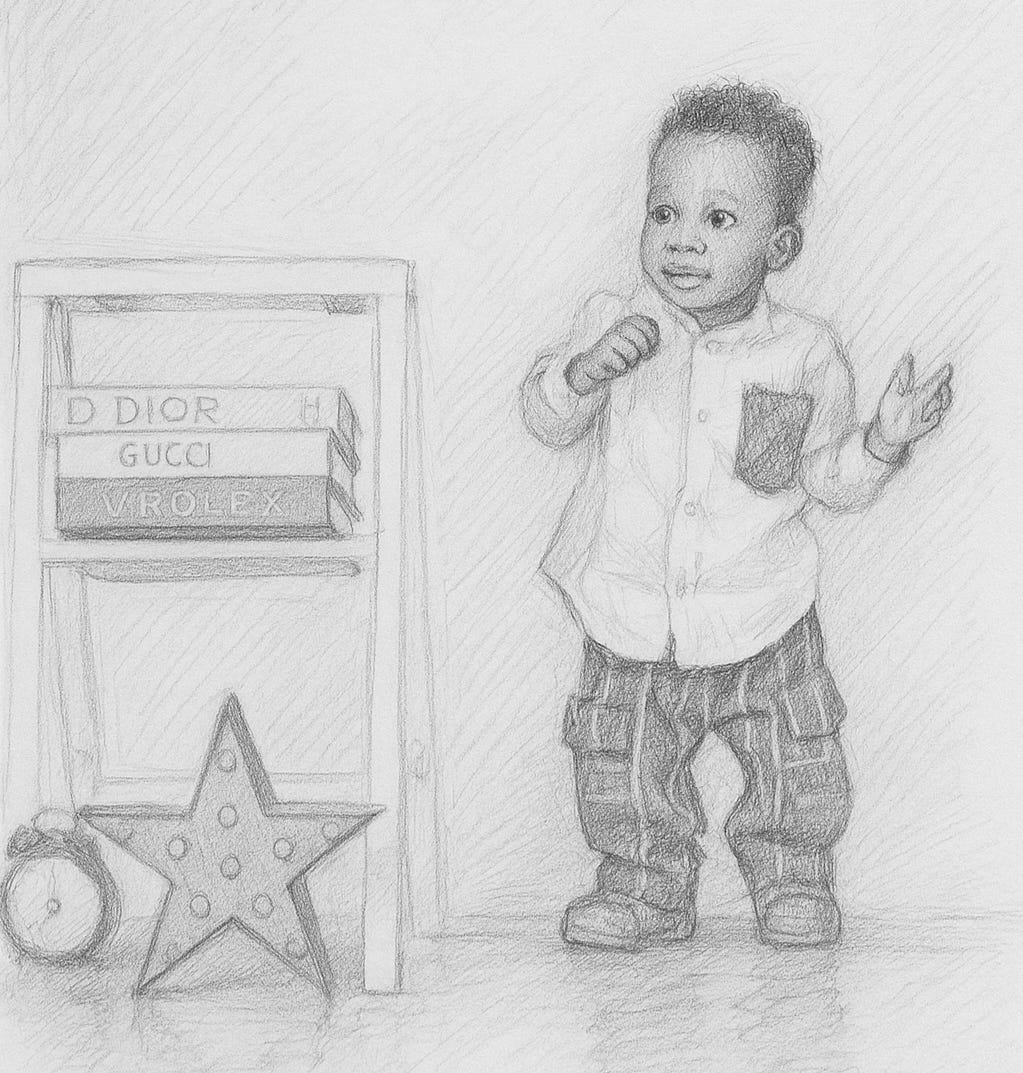
From tiny kicks to big giggles, our world got brighter one year ago when we had Adnan, who I fondly call Aboki. We are today in the celebration mood, so I won't talk much about my wife's trouble through pregnancy and her labour. Friends, it is indeed labour. It is called labour for a reason... I'm happy for her, that in all her fragility, she came through. Childbirth is a thing that alters woman's being forever, and I pray that every alteration brings joy to her, Arikẹ, in the end.
Maybe someday, I'll talk about my trouble through the times. My fears. My tears. My restlessness. And how the experience is like a brute force attack on man's being. In all the vulnerability, I pray that Aboki keeps being the coolness of my eyes.
Happy 1st birthday, son, this Saturday, 23rd August, 2025.
2. What goes on in the minds of babies?
Whenever I play with Aboki for a very long time, or I watch him play alone around the house, I wondered what goes on in his mind. By extension, I asked myself: What goes on in the minds of babies? In that state of theirs, what does consciousness feel like? They are born in clean slate, tabula rasa, how does their surrounding alter the slate into awareness?
Barely 2 months, my son already knew me. When he was 4 months old, we had started playing much more together. Unlike when I'd be the one trying to engage him, he had started trying to get attention. He would laugh, giggle, smile. I use to wonder how he has become aware of his environment.
When he saw me, he already knew that it's me, at 4 months. Like, if he was crying in people's arms and I retrieved him from them, he stopped crying and sometimes began to laugh. Sometimes, he'd extend his hands towards me. He knew me already at 4 month, just like my cat, Pàsó, knew me. And now that he is one year old, and can already call Bàbá, and sometimes Daddy, he knows me even better.
And then, I ask, God forbid that I die today, will my son still know me as he grows? Will he remember me when he grows up? As in, can he recall our playful moments, of laughs, tickles, giggles, and all that? When do their complete awareness and full consciousness begin?
For me, I can recall what happened to me as far as around my 3 years of age. I think having photograph sessions of the events helped me with retaining the events in my mind. There is a particular picture of me and my twinnie at 3. I can clearly recall how I dressed up for the shoot, walked out of the room, climbed a table and posed for the picture. In fact, I can remember the photographer—Iya Sheu, who was our family photographer for years.
Away from sweet moments captured in photographs, there were events that came from pain. So intense that they are etched in my memory for life:
Like the time I had a swelled up buttock from injection. I recall how the dangerously shiny instruments were assembled: knives, scissors, and whatever they are called. And how they are made to get rid of the purs that grow in my buttock.
Like the day I poured a sugar-looking alchemy in my mouth.
Like when broomsticks assembled on a halved piece of sugarcane was beaten into my ears, I can still see myself running upstairs to meet my parent. It seems I still have that damn broom in my ear.
Like the day I vomitted from nursery class on my way back home. My uniform short, burdened by vomit, I carried it halfway home before someone helped wash it and wiped my face.
Like the day I had a 10 kobo coin in my mouth and climbed on my brother for the "ẹṣin kùtàkùtà" game, and suddenly, the coin slipped in my throat. I went through hell. When Dad returned almost some minutes later, even as I was afraid of telling him what actually happened, my reddened eyes was a great concern. I think I told him I was pepper-chocked. He added milk to his pap and asked me to drink. When he was going back out, he left me with "Mummy nurse" to cater for me, who gave me a container of a chewable tablets to chew.
But why can't we recall periods from 8 months to 2 years old. For instance, I can't recall my father lifting me up and laughing at me at that age. I sure know he'd have done that a lot of time. Although I would later know that father didn't always like to carry infants due to their fragile self and the fear of manhandling them, I also know the he was fond of kids, and his own children. Even at 30, he'd still sing for me (sort of lullaby) whenever we speak on phone, or I visit. So even if he won't be lifting me in his hands, I'm sure he would be lulling me and playing with me. But I can't picture that.
Friend, can you recall or have you seen anyone who can truly recall events of himself when he was 2 years old or below? Cuz, when I see my pictures of times before 2 years old, I could not remember how they happened.
My Philosophy: Taking pictures of certain events is helpful. I think it sharpens memory. It will help kids recall events, or help them retain the events in their memories, thereby rubbing off on their studies and critical endeavours.
What do you think?
Do you agree with me?
What preteen experience would you love to talk about?
Share in the comment.
Ọdàbọ̀, kó si àdìtú tí a kì í tú.
(Farewell, and may no mystery remain unsolved.)
ASWAGAAWY
the toothpick that walks like a man